18 November 2026
After nine years, whale-watching companies are shuttering their operations during what is usually peak season. The Skjervøy era is over. What does this mean for the future of winter whale watching in Norway?
As I write this, an era is coming to an end. After nine consecutive winter seasons in the fjords outside Skjervøy, the winter whales have finally moved decisively towards Alta — as has long been anticipated. According to friends in the industry, the whale watching season had got off to a fairly normal start in October, but it quickly became apparent that there were historically low numbers of orcas in the fjords, and not many humpback whales either. Still, few expected the whales to so abruptly disappear in the middle of November, usually the peak month. Now, numerous companies large and small are cancelling tours and winding down their operations.
Reports from Alta, where some whale watching companies had already preemptively moved last season, suggest that orca and humpback whale presence is strong. Yet if Alta is to become the new base for this moveable feast, other questions remain unresolved. Will the same problems trail the industry there? What kind of regulations, if any, will be put in place to control its growth?
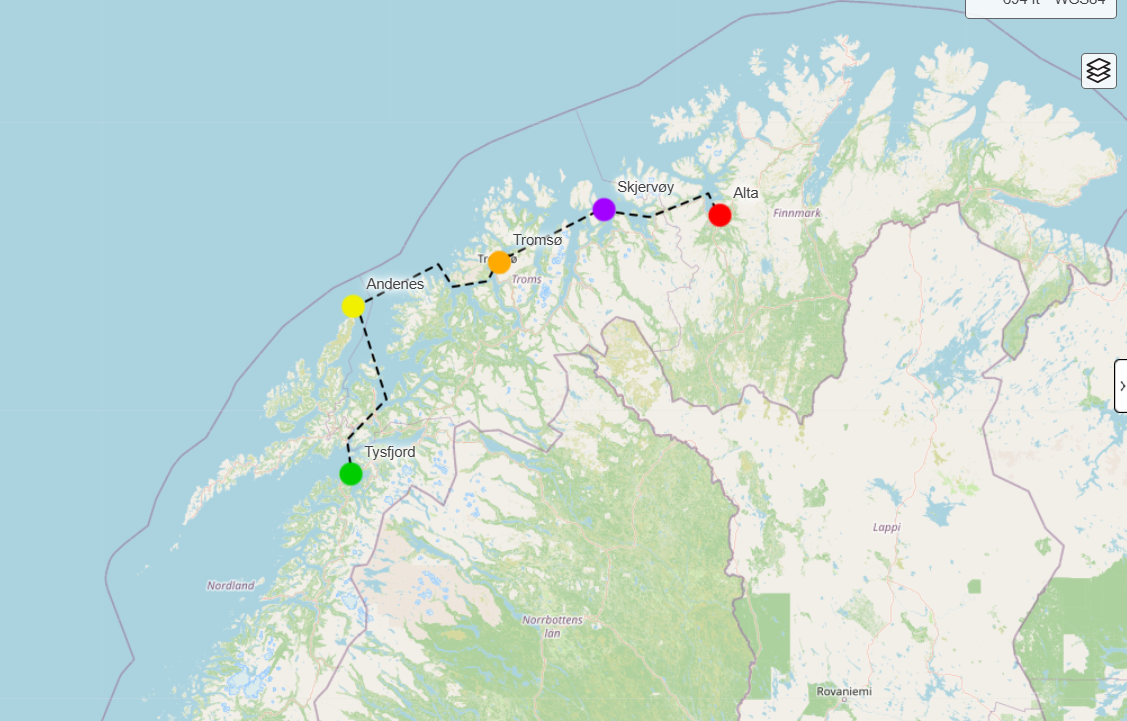
Land outposts close to NSS herring overwintering locations, mid-1980s (Tysfjord) to present (Alta). Map created using caltopo.com.
Why are the whales moving?
The reason the whales are moving at all is down to a little silvery fish called the Norwegian spring-spawning (NSS) herring, which is known to shift its wintering ‘grounds’ periodically. NSS herring typically overwinter in enormous schools in sheltered fjords along the Norwegian coast, and they are followed by whales who feed on them: killer whales (or orcas), humpback whales and fin whales. Since the mid-1980s, the herring have overwintered in different locations up the coast of Nordland and Troms counties with the whales in tow. They first arrived near Skjervøy in winter 2017-18. As word spread, increasing numbers of tourists — especially snorkellers — have followed.
So why do the herring move? A few factors appear to be at play, chiefly rising sea temperatures owing to climate change, and the age class of the fish. Ocean temperatures have been rising for decades, and waters along the Norwegian coast have become 1-2ºC warmer since 1935, outpacing the global average. Successive marine heat waves have hit the North Atlantic since the 1950s, and many fish species are moving further north in search of cooler temperatures. That may be why the herring have travelled in a roughly northeast trajectory.
One of the most compelling theories to date about why herring move relates to the ‘culture’ encoded within their schools. Herring are hypothesised to be led by older, larger fish within the school, but when those individuals are fished out by commercial fisheries, the younger, smaller, less experienced fish are left without guides. Essentially, the school’s collective memory gets disrupted and the younger fish, with no one to follow, must figure out the best place to go next. While this explanation relates more to NSS herring spawning grounds than their overwintering grounds, the idea that fish ‘socially learn’ from one another is fascinating, and as the authors of the paper suggest, fisheries policy should take this into account.
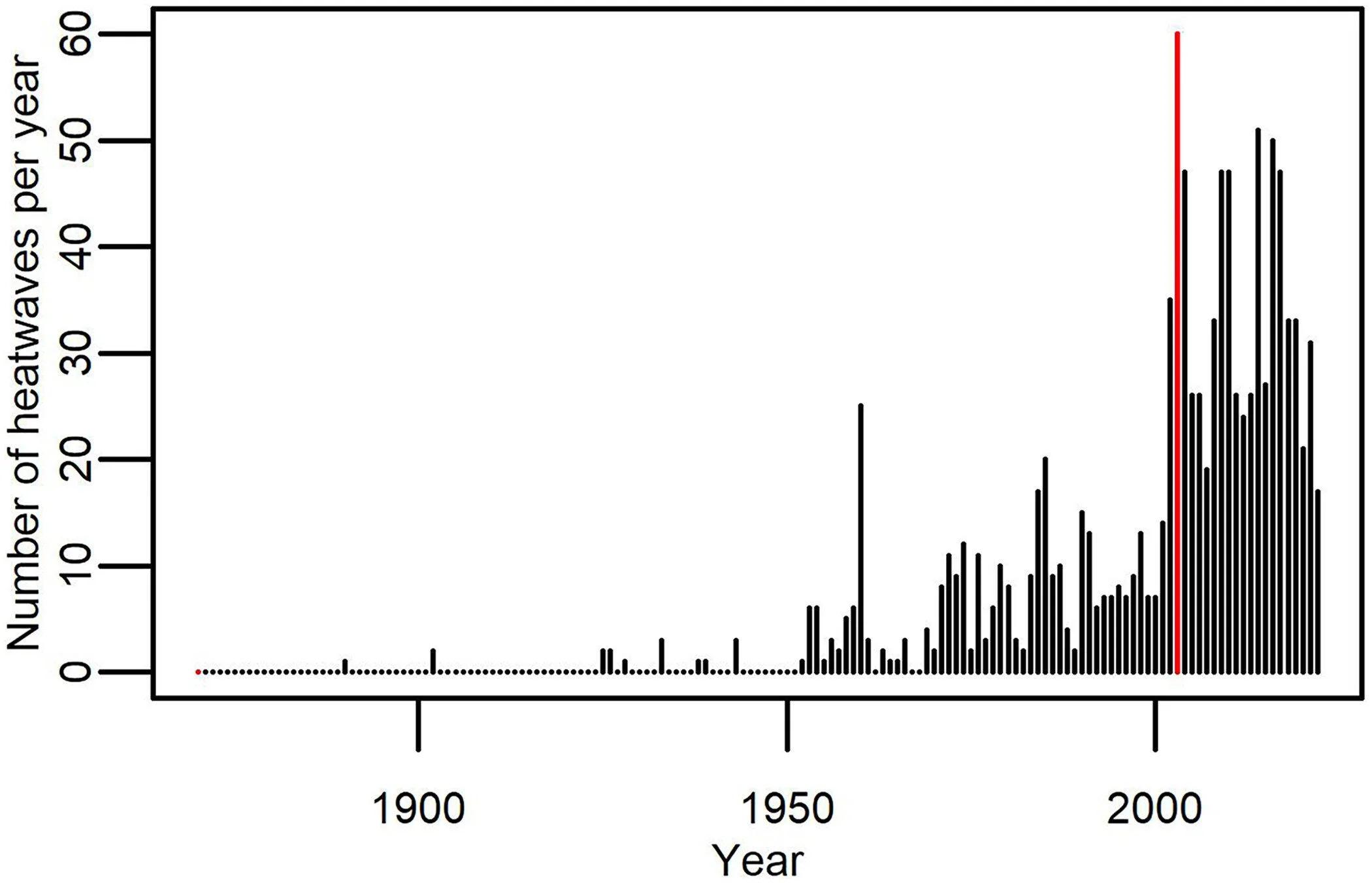
Graph depicting incidence of marine heat waves in the North Atlantic ocean. Source: https://www.science.org/doi/10.1126/sciadv.adt7125.
The ongoing regulations debate
At least since the whales reached the waters outside Tromsø in 2011, concerns have been raised again and again in in-person and online forums, as well as local, national, and international media. Complaints primarily focus on poor seamanship, harassment of whales, unchecked numbers of boats, and the presence of non-tax-compliant foreign operators. Current regulations are lax by international standards, with no definition given for what constitutes ‘disturbance’ to whales. Nor do they specify the distance to be maintained between boats and animals, or maximum boat speed. More detailed guidelines and workshops have been developed by industry actors, but these are voluntary.
Norway is also one of the only countries globally without legally binding rules for snorkelling with whales. The law only stipulates the distance whale watching boats (370 m) and snorkellers (740 m) must keep from active fishing vessels. The Fisheries Directorate has reportedly increased its presence in the fjords to ensure compliance with this rule of late. But the government minister responsible warns that stricter legislation for the whale watching industry will not be forthcoming until the 2027 season.
Meanwhile, scarcity breeds poor boater etiquette: as numbers of whales shrink, operators get desperate. Just a week or so before many companies decided to shutter their operations in Skjervøy for good, Norwegian Orca Survey, a well-respected research NGO, documented a staggering 70 boats going to and from a single pod of nine orcas. This tops even last year’s reported high, which saw some 26 boats concentrating in a small area around sperm whales. Anecdotally, boat numbers have been higher than that for years, and the crowdedness can be shocking to witness for tourists and workers alike.
A busy day snorkelling, winter 2023-24.
Regulations in the Alta era
In principle, whale watching from Alta need not be different to that in Skjervøy. However, many seeking stricter regulations would like it to be. Part of the issue with developing fair regulations is the in-fighting and finger-pointing among operators. There is also the seasonal nature of the industry: once the whales move on at the end of January, media attention dies down and violations fade from memory. The whales’ move to Alta could represent a great opportunity to draw a line under the chaos of the previous era and to start again, this time on better regulatory footing.
Skjervøy’s proximity to Tromsø, the hub of Arctic winter tourism, no doubt put it under great pressure during its tenure as the gateway to the whales. Alta is a much larger town accessible by direct flights from Oslo, but it is six hours by bus from Tromsø, and much more by sea. This means that bigger vessels docked in Tromsø will no longer be able to offer whale watching in Skjervøy as a day trip. This may reduce some of the numbers of boats in the short term, although many operators will no doubt relocate and run trips out of Alta instead. Alta is also known for being colder than Skjervøy on average, which could make snorkelling more challenging. What this ‘new’ iteration of winter whale watching will look like remains to be seen, but hopefully it will be accompanied by better protections for the whales.
Goodbye to Skjervøy
Many tourist dreams will be dashed by the sudden departure of the whales this season, but it was always going to come to an end at some point. For captains and guides who have worked for many years in Skjervøy, becoming familiar with its shops, mountain views and Saturday morning cake at the hotel, this is a wistful moment of transition and great uncertainty. Despite the problems that have in some ways become emblematic of the Skjervøy era, the town and its fjords have also served as a place of wonder and research opportunities for many young scientists for almost a decade. All kinds of research has been enabled by the whales’ presence here, whether on novel multi-species feeding aggregations, whale acoustics, depredation — or even my own on tourist experiences of snorkelling in an overcrowded place. Teams, friendships and social networks will now have to reassemble in Alta.
Saying goodbye to Skjervøy will make many hearts heavy, including my own. This is a cosy, friendly town with a twinkling charm; it is much smaller and less tourist-heavy than Tromsø, while still being quite well connected by bus, speed ferry and Hurtigruten/Havila. During my own time there as a researcher/guide in the winters of 2023-24, 2024-25, and for the last time in January 2026, I always felt alive to its magic. I got to see northern lights, polar stratospheric clouds, and so many whales — but most importantly, I lived and worked alongside people who became good friends.
What will become of it now? Although the whales have undoubtedly brought seasonal economic benefits to the town, I always admired the nonchalance of many locals. One longtime resident once said to me, with a shrug, that ‘the tourists came before the whales, and they will come again when the whales are gone’. Some of that tourist energy may now be coming to Alta, and Skjervøy can adapt to a different status again. As a wise man once sang, all things must pass.
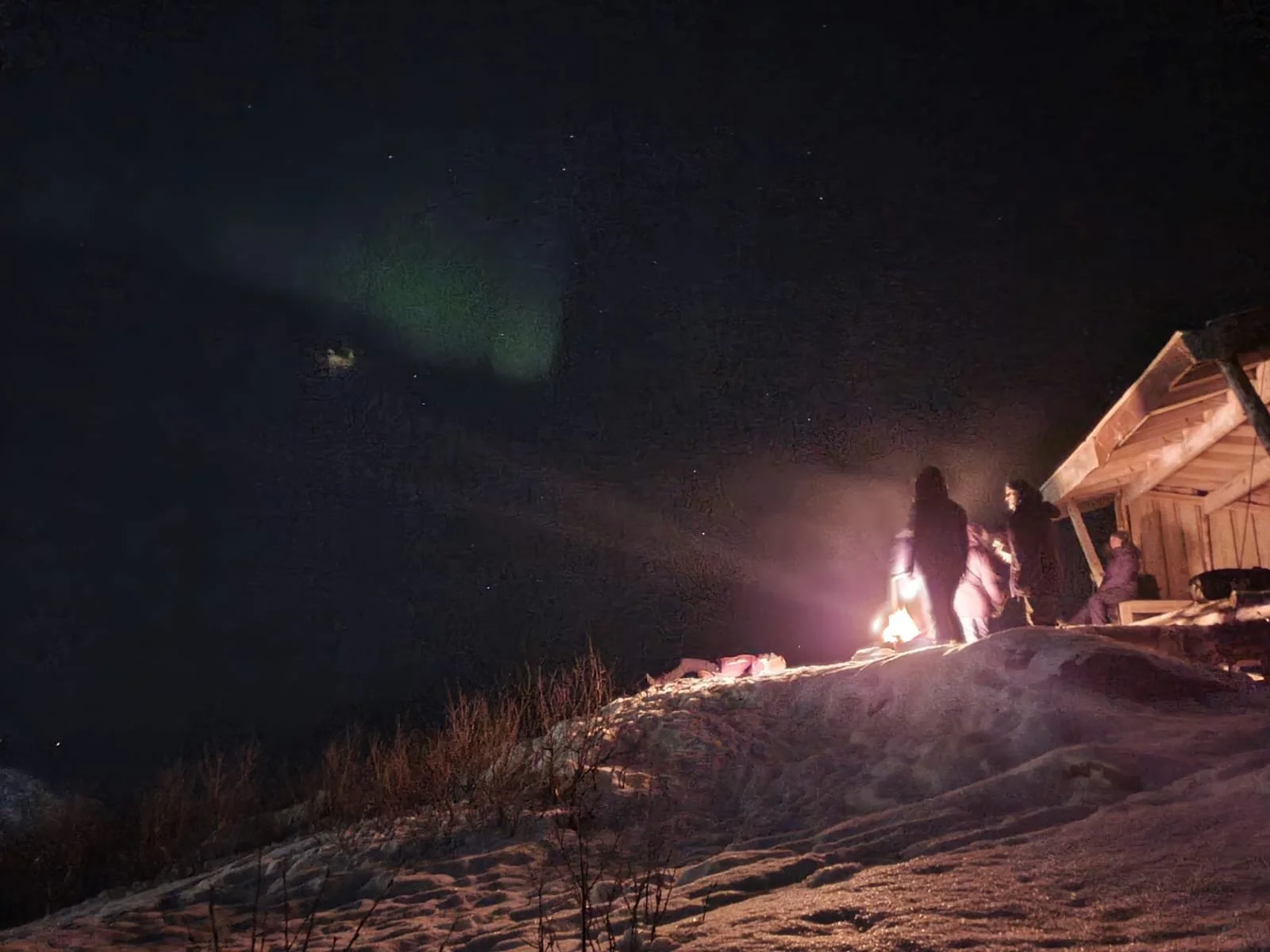
Watching the northern lights with teammates at the top of a hill in Skjervøy, December 2023.